
BAFTAs vs. Black Awards: Why Don't We Celebrate Ourselves?
The industry reaction to the vile racist incident at the BAFTAs is a reminder to Black creatives that no matter how many accolades we receive, there’s no place like home.

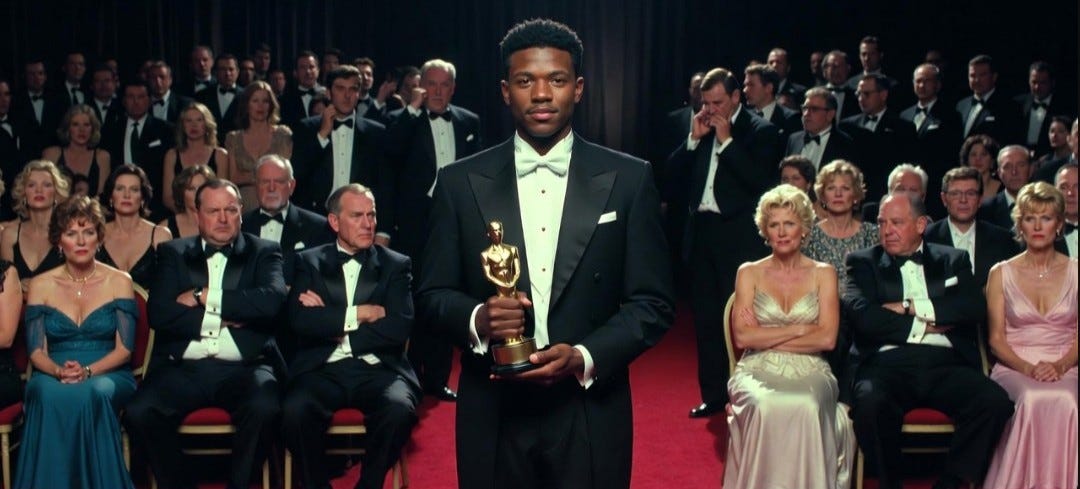
By Torraine Walker
The film Sinners is racking up awards like the ‘91-’93 and ‘96-’98 Chicago Bulls racked up championships. With 225 current award wins and 16 Academy Award nominations -the most in film history- Sinners is poised to rewrite the rules of what success looks like in entertainment. But it hasn’t been all love. There was an article in Variety magazine that downplayed the film’s success on its opening weekend as well as grumbling from some critics who claimed not to understand the film or claimed it was derivative. None of that has stopped the film’s motion, but recently the industry allowed a quiet sentiment to be said out loud.
On February 23, Autism sufferer and activist John Davidson shouted “nigger” at Michael B. Jordan and Delroy Lindo while they were on stage accepting awards at the British Academy of Film and Television Arts ceremony or BAFTA Film Awards. On February 28, Jordan, Lindo, and Director Ryan Coogler and the cast of Sinners received standing ovations at the NAACP Image Awards. Many people saw this as a safe and healing space among our people to wipe away the disrespect they received in London.
The fact of Davidson’s illness is one thing. The fact that the slur was allowed to go out on the air when other statements were censored, and the spirited defenses of Davidson and demands from British film industry and autism advocates for Jordan and Lindo to show grace after having their moment marred is another. With these recent events, my question is, should we celebrate ourselves again?
The origin of Black awards shows like the Image Awards, the BET Awards and the Soul Train Awards was for Black entertainers to be acknowledged and rewarded for their talents in a white dominated industry that deliberately ignored them or relegated them to transient diversions. As Black entertainers began to take over pop culture, they were integrated into the American mainstream of awards ceremonies to the point that major Black entertainers stopped showing up for Black created ones.
It’s a phenomenon with parallels in Black economics. Malcolm X said that as soon as the ink was dry on the 1964 Civil Rights Act, those Black people who could were knocking themselves over to run and spend money in restaurants, hotels and neighborhoods that would have had the police throw them out a week before.
For some Black people, movin’ on up provides a sense of validation and self-worth, proof of our value and that we’ve “made it”. But integration at the expense of everything meant that we abandoned the infrastructure and cultural institutions we built up over the previous century.
Another phenomenon - one we don’t like to talk about - is the belief among far too many Black people that the things we create for ourselves are substandard compared to what other groups sell to us. Said another way, we believe “the white man’s ice is colder.” We are hypercritical of Black businesses but will go broke paying top dollar for European luxury brands even after they have insulted us.
Black entertainment and culture for all intents and purposes is mainstream American entertainment culture now, and its influence is global. But to quote Delroy Lindo’s Sinners character Delta Slim: “See, white folks, they like the blues just fine. They just don’t like the people who make it.” The BAFTA incident is proof of how true that still is.
I’m not saying that Black creatives should retreat from accepting every accolade available, just that we need to look at honoring ourselves as a starting point and not a consolation prize.
Thanks for reading! If you like my work, help more people discover it by telling your friends to subscribe to my Substack!
Join the Torraine Walker Roundtable! Click the link to subscribe to my free newsletter!
You can also support my work by donating via CashApp, PayPal, Venmo, or joining my Patreon. Thanks!